

In the digital-first era of today, success in the hospitality sector depends on effective digital marketing for hospitality. Hotels, restaurants, and travel companies are discovering that strategic hotel digital marketing not only generates visibility but contributes to authentic guest engagement and loyalty. This blog examines how to best achieve current best practices and upcoming trends in digital marketing for Guest services specifically for hospitality companies.
What Does Digital Marketing for the Hospitality Sector Mean?
Digital marketing for hospitality is the process of using online media, platforms, and technologies to market hotel properties, restaurants, and travel experiences. For hospitality companies, it is a shift away from the old ways of marketing (print advertising, billboards, relationships with travel agents) to reaching potential guests where they spend most of their time—online.
This approach to hotel digital marketing includes everything from search engine exposure and social media activity to email marketing and reputation management online. As opposed to older forms of marketing, online channels provide the opportunity for unmatched targeting, instant real-time measurement, and instantaneous optimization of campaigns according to results.
What is Marketing for Hotels Exactly?
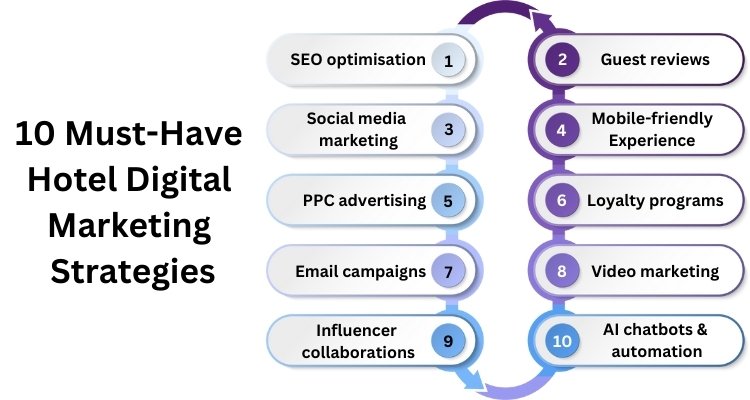
Hotel digital marketing specifically includes several integrated components:
- Optimisation of websites for direct reservation – Building an unbroken booking process to turn browsers into bookers
- Search engine marketing – Paid and natural SEO and advertising to reach travellers who are searching actively for accommodations
- Social media – Presence on social media channels where travellers look for inspiration (Instagram, Facebook, Pinterest)
- Email campaigns – Personalized communications for various points of the guest lifecycle
- Online reputation management – Constant monitoring and replying to reviews on multiple sites
- Content marketing – Developing worthwhile content emphasizing one-of-a-kind property amenities and local culture
- Metasearch engine presence – Visibility on Google Hotel Ads, Trivago, and other price comparison tools
Revenue Marketing: What Is It?
Revenue digital marketing is where revenue management intersects with digital marketing for Guest services approaches. Specifically, this process centres on:
- The use of digital distribution for generating direct business (elimination of OTA commission)
- Utilisation of dynamic pricing models within digital channels
- Influenced targeting of higher-spending segment groups via digital
- Utilising analytics to locate optimal guest revenue-maximizing sources
- Suggested personalising cross- and up-sells based on a comprehensive digital journey understanding
- Fine-tuning booking engines for higher conversions
- A/B testing landing pages and booking processes to improve revenue per visitor
This process guarantees that the hotel’s digital marketing activities directly relate to driving revenue, where there is definitive ROI tracking and accountability.
Digital Hospitality: Extending Guest Service Online
Digital hospitality expands the traditional in-person concept of guest service to the online space. It understands that the guest experience is created well in advance of arrival and continues on beyond departure. Key components of digital marketing for hospitality are:
- Designing frictionless digital touchpoints that reflect the hospitality of in-person service
- Customising the online experience based on guest behaviour and preference
- Providing digital concierge services through chatbots, apps, and messaging platforms
- Providing mobile check-in/check-out and keyless entry
- Offering in-room digital services (entertainment, room management, service requests)
- Keeping guests engaged with personalised follow-up messages
- Creating online communities centred on common interests tied to the property or destination
Digital hospitality recognises that guests today expect the same quality of service and personalisation online as they do on the property.
Understanding the Digital Guest Journey
Today’s travellers and diners start their journey online well before they reach your doors. More than 85% of travellers utilise digital tools to plan their trips, and 79% of diners read online reviews before selecting a restaurant, according to recent industry reports. Knowing this digital guest journey is essential for reaching potential visitors at every stage of decision-making through resort digital marketing.
The average guest journey is:
- Awareness & Inspiration
- Research & Comparison
- Booking Decision
- Pre-arrival Engagement
- On-property Experience
- Post-stay Relationship
The Impact of Internet Marketing on the Hotel Sector
Digital marketing for hospitality has fundamentally transformed the hotel industry in several ways:
- Disintermediation of historical distribution chains – Direct hotel-to-guest contact, cutting ties to travel agencies and tour operators
- Higher transparency in prices – The guest has a better means of comparing prices on multiple hotels and sites
- The democratisation of reputation management – Guest word of mouth outweighs professional assessment or brand value
- Change in reservation behaviour – Briefer time frames in bookings and greater bookings via the internet
- Data-driven decision making – Availability of in-depth analytics regarding guest behaviour and preferences
- More sophisticated competitive environment – Competition now involves alternative accommodations such as vacation rentals
- Increased guest expectations – Guests anticipate smooth digital experiences and personalised service
These changes have required hotels to develop new competencies and strategies to remain competitive in hotel digital marketing.
Why Does the Hospitality Business Need Marketing?
The hospitality industry has unique characteristics that make effective digital marketing for accommodations essential:
- Perishable inventory – Unsold room night is irreversibly lost revenue
- High fixed costs – High occupancy rates are required for properties to offset operating costs
- Growing competition – Both from established competitors and new accommodation choices
- Experience-based product – The intangible nature of hospitality demands successful storytelling
- Emotional purchase decisions – Travel decision-making is typically guided by emotions and not hard logic
- Seasonal fluctuations in demand – The majority of properties experience strong occupancy fluctuations during the year
- More fragmented market – Increasing travel and guest segment diversity
Effective marketing addresses these challenges by building demand, creating emotional connections with potential guests, and strategically managing revenue opportunities.
How Hotel Digital Marketing Initiatives Can Increase Online Visibility
Increasing online visibility through digital marketing for hospitality requires a multi-faceted approach:
- Technical SEO optimisation – Ensuring websites are mobile-friendly, fast-loading, and structurally sound
- Local search strategy – Optimizing for “near me” searches and maintaining accurate location information
- Content marketing – Creating valuable resources that answer common travel questions for your destination
- Strategic social media presence – Building engaged communities on platforms aligned with target guests
- Online PR and influencer partnerships – Generating digital coverage from trusted sources
- Video content strategy – Developing engaging video content for YouTube and social platforms
- Voice search optimisation – Adapting content for conversational queries and virtual assistants
- User-generated content curation – Encouraging and highlighting guest photos and experiences
Properties that excel in these areas typically see significant improvements in search visibility, direct traffic, and social engagement.
Calls to Action’s Role in Implementing Digital Marketing Strategies
Effective calls to action (CTAs) are critical to converting digital marketing for accommodations efforts into tangible results:
- Strategic placement – Positioning CTAs at key decision points in the digital guest journey
- Value-driven messaging – Communicating clear benefits rather than just actions (“Secure your ocean view” vs. “Book now”)
- Creating urgency – Using scarcity and limited-time offers to encourage immediate action
- Personalized offers – Tailoring CTAs based on guest behaviour and preferences
- A/B testing – Continuously optimizing CTA design, placement, and messaging
- Mobile optimization – Ensuring CTAs are easily clickable on smaller screens
- Clear next steps – Removing friction from the process after a CTA is clicked
Well-designed CTAs can dramatically improve conversion rates across all digital channels, turning interest into actual bookings.
Essential Digital Marketing Channels for Hospitality
1. Responsive, Experience-Centric Websites
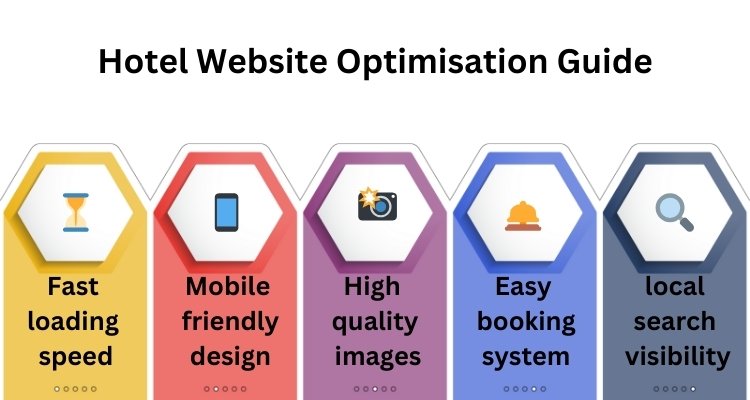
Your site is still your most valuable digital asset in resort digital marketing. Above and beyond fundamental functionality, modern hospitality sites are required to:
- Include high-quality visual content with experiences
- Deploy streamlined booking paths with few clicks
- Use virtual tours and experiential content
- Load fast (less than 3 seconds)
- Include reviews and social proof
2. Search Engine Optimization (SEO)
Local SEO is especially important for hospitality companies implementing digital marketing for hospitality:
- Optimise for location-based phrases (“boutique hotel in Charleston”)
- Keep the entire Google Business Profile up to date with frequent changes
- Create location-targeted landing pages for multi-location properties
- Develop local experience and neighborhood guide content
- Establish local backlinks from community partners and tourism boards
3. Hospitality Content Marketing
Content that inspires and gives value works best in accommodation digital marketing:
- Destination guides to feature local attractions
- Sneak peeks of your property or restaurant
- Chef interviews and signature dish spotlights
- Guest experiences and highlights
- Travel tips and seasonal recommendations
4. Social Media Strategies
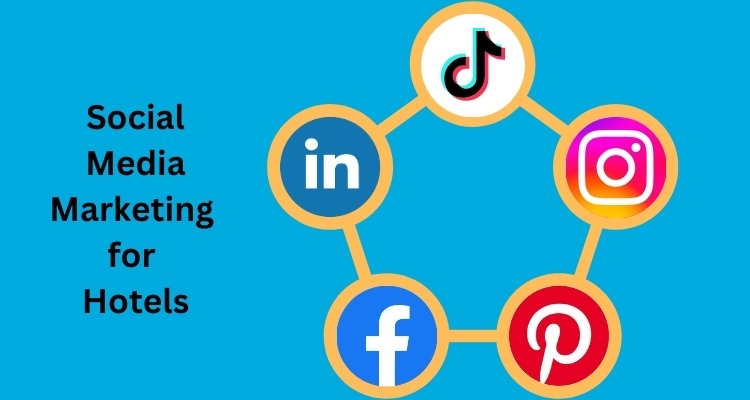
Platform-specific strategies work best:
- Instagram: Visual storytelling, reels highlighting property features, influencer partnerships
- Facebook: Community building, event promotion, targeted advertising
- Pinterest: Wedding inspiration boards, travel planning, and decoration
- TikTok: Real behind-the-scenes material and trend engagement
5. Email Marketing Excellence
Personalized email campaigns continue to deliver strong ROI:
- Pre-arrival communications with local information
- Post-stay thank you messages with personalized offers
- Loyalty program updates with exclusive benefits
- Seasonal promotions targeted by guest history
Emerging Trends in Hospitality Digital Marketing
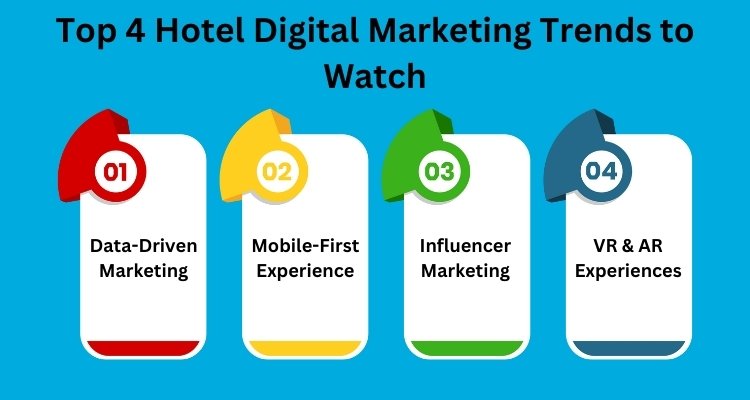
1. First-Party Data and Personalization
With third-party cookies going away, gathering and using first-party data is more crucial than ever for digital marketing for hospitality:
- Deploy thorough CRM systems linked across touchpoints
- Build custom guest profiles around preferences and behaviours
- Make targeted offers based on past stay history
- Apply AI-powered recommendations to upsell
2. Voice Search Optimization
Voice search just keeps getting bigger in accommodation digital marketing:
- Optimise for conversational queries (“Where’s the closest hotel to Central Park?”)
- Add FAQ pages with natural language responses
- Make local listings thorough for voice assistant suggestions
3. Sustainability Communications
Environmental awareness has shifted from niche to mass expectation:
- Transmit sustainable initiatives authentically
- Create content for green projects
- Emphasize local supply and community alliance
4. Virtual and Augmented Reality
Immersive technology is reshaping the reservation process:
- Virtual home tours facilitating room-by-room walkthroughs
- AR apps supplementing on-property activity
- Virtual visualization of event spaces for planners
FAQs for Digital Marketing for Hospitality
Local SEO is necessary for hotels and other hospitality companies since the majority of travellers look up where to stay in a particular area. Effective local SEO gets your facility in front of customers in “hotels near me” searches, Google Maps, and location-based searches. This generates both online reservations and in-person visits, especially for last-minute travellers. Local SEO also enables your smaller property to compete with bigger chains by claiming specific geographic search real estate.
Maximize your hotel website for direct bookings by having a simple booking engine, designing a mobile-friendly layout, emphasizing a best rate guarantee, using clear calls-to-action, featuring high-quality images and videos, including guest reviews, providing website-only packages, streamlining the checkout process, and optimising page loading speeds to minimize abandonment rates.
Successful PPC hotel strategies involve bidding on branded terms, targeting high-intent keywords such as “book hotel in [location],” using remarketing campaigns for abandoned bookings, setting up location-specific ad groups, employing hotel-specific ad extensions highlighting amenities and reviews, varying bids by season, utilizing Google Hotel Ads, and setting up distinct campaigns for mobile users who tend to book last-minute.
The best hotel digital marketing content is virtual tours, high-definition photography and videos of rooms and facilities, local area guides, behind-the-scenes views, guest reviews, staff interviews, dining experiences, seasonal package offers, local event calendars, and blog posts on surrounding attractions. Satisfied guest user-generated content also works extremely well for trust-building.
Hotels are able to take advantage of Facebook and Instagram by posting visually beautiful property photos, taking virtual tours, executing targeted ad campaigns, hosting contests and giveaways, including user-generated content, utilizing Instagram Stories for behind-the-scenes pieces, offering special promotions, showing local experiences, utilizing strategic hashtags, and commenting and messaging directly with potential travellers to establish a relationship.
AI is transforming hospitality online marketing in terms of tailored suggestions according to the guest’s preferences, AI-powered chatbots for round-the-clock customer care, predictive pricing based on past demand trends, intelligent email marketing automation, guest review sentiment analysis, customized retargeting campaigns, voice search optimization, visual recognition to track brand mentions, and data analytics that spot booking trends and opportunities.
The most current trends in hotel digital marketing in 2025 are voice search optimization, hyper-personalization with AI, greater focus on messaging sustainability, experiential marketing with immersive content, greater attention to collecting first-party data, micro-moment marketing targeting key travel decision moments, better virtual and augmented reality experiences, smooth omnichannel strategies, and blending of digital technology into the physical guest experience.
AR/VR in hotel marketing provides engaging experiences that allow prospective guests to explore hotels virtually prior to a reservation. Virtual reality delivers a 360-degree tour of the room and walkthroughs of the facility, and augmented reality brings the physical space alive with digital content on amenities. These solutions drive booking confidence, lower cancellation rates, assist with event space displays, and facilitate shareable moments that set your brand apart.
Hotels can improve Google rankings by optimizing for local search keywords, having an active Google Business Profile, being mobile-friendly, optimizing page load speed, creating quality backlinks from travel sites, developing location-specific content, using schema markup, having consistent NAP (name, address, phone) data across the web, getting positive reviews, and updating website content regularly.
Influencer collaborations help hospitality brands reach intended travel consumers organically, create high-quality visual content, establish social proof via third-party recommendations, boost brand awareness, drive direct bookings via affiliate links, develop shareable content that extends reach, tap into new markets, strengthen content marketing strategies, and offer new insights into property amenities that may be missed by traditional marketing.
Hotels usually spend 4-8% of their revenue on marketing, with digital advertising accounting for 50-70% of that. New hotels or hotels in rebranding might bump this up to 10-15%. Budgeting should be seasonally adjusted, with increased spending during booking windows for peak periods. Prioritize calculating return on ad spend (ROAS) instead of fixed percentages to maximize marketing spend.
Reviews on the internet are important to hospitality companies since most tourists read them prior to booking a place. Good reviews help to establish credibility, improve search engine rankings, affect booking choice, offer feedback for process optimization, boost click-through rates on OTAs and Google, enable premium pricing justification, and are strong social proof. Every half-star rating rise can substantially grow occupancy levels.
Drone imagery is advantageous for hotel marketing by the display of property size and surroundings from unusual angles, emphasizing proximity to attractions, illustrating beachfront access or scenic views, explaining context of the property’s location, producing shareable and memorable social media content, distinguishing your property from others through ordinary photography, and evoking emotional connections with potential travelers through cinematic visual experiences.
Track reviews on sites such as Google, TripAdvisor, and Booking.com, reply professionally to comments, and invite happy guests to post positive reviews.
Engaged guests are more likely to return, leave good reviews, and recommend the hotel to others.



0 Comments